skip to main |
skip to sidebar
The NCAA released its penalty report on Penn State
University this morning and while the media extols how
severe it was, I disagree.
Let me assert right from the start that I am a SMU
alum and might be bias a degree or two in this matter.
The NCAA placed Penn State on probation for five
years, fined them 60 million dollars, cut ten scholarships
per season for the next four years, forbid them from any
post-season bowl games for four years, deducted all victories
from 1998 to 2011 from the record of the school and coach,
and forced the school to be academically responsible to the
NCAA for five years. Severe, to be sure, but now let's compare.
In 1986 SMU was dealt the 'death penalty' by the NCAA and
NO FOOTBALL at all was allowed during the 1987 season.
Players with eligibility remaining were allowed to transfer to
another school immediately and they deserted SMU like rats
leaving a sinking ship. With the few players left SMU decided
they could not compete in 1988 and voluntarily forfeited that
season also. A Hall of Fame coach was brought in to help the
Mustangs return to college football in 1989 without success. It
would be twenty-five years before the Dallas school would have
a season worthy enough to warrant a post-season bowl invitation.
The death penalty not only killed a proud program at SMU but
also spelled doom for the historic Southwest Conference. Without
SMU on the schedule, Rice, Houston, Arkansas, Texas, Texas Tech,
Texas A&M, and TCU had to find games elsewhere. The frantic search is still being felt in 2012 as the other schools look for a conference to call home.
What did SMU do to warrant the death penalty? They paid a few student athletes to attend SMU over offers from other schools. When the NCAA discovered this violation of rules SMU was cited and put on probation. Some of the players that were not discovered in the first violation wanted to keep getting paid, and SMU wrongly
kept paying them as per their original contract. Bob Hitch, the SMU
athletic director at the time, even sent money to one of the players in a school envelope with his name on the return address. How stupid can a person be? When the NCAA discovered violations still being made at SMU the guillotine dropped on the Mustang program.
What happened at SMU was also happening at other schools in the
conference but they were not as blatant. Who do you think blew the whistle to the NCAA?
While there was speculation about Penn State receiving the 'death penalty' I knew the NCAA would not duplicate their 1987 decision.
Penn State is the largest school in the state of Pennsylvania, and the NCAA does not want to lose the revenue generated by the big state schools. The University of Texas, Texas A&M University, and Texas Tech University have all been found guilty of the same violations as SMU, but were never handed as harsh a penalty. The gutless NCAA needed a small church sponsored school to use as an example for others and they found it when SMU suddenly was able to compete with the big schools of the Southwest Conference in the mid 1980's.
It was those same schools that turned in SMU when they lost out on the recruiting battles. They did do a better job of cheating than SMU, so history continues to point out the Mustangs as the only school ever handed the death penalty.
What was the most serious offense? One school was guilty of paying players to compete at a Division I school against competition of an equal level. The other school guilty of harboring and providing a pedophile with a supply of young boys. Even the adopted son of assistant coach Jerry Sandusky testified he raped him in the basement of his home. Most of the other boys were molested in the showers of the athletic department of Penn State. There is no comparison of the two violations, but the NCAA made their decision.
Considering what could have been... Penn State got off lucky!!
If you don't know,... I retired from 30 years as a Radio/TV broadcaster. Most of that time was spent behind the microphone at various radio stations...
Having said that,..I still have a fond affection for old Radios. I have several of the old 'stand-up radios',..sometimes called floor models. Also a 1937 cathedral-back Philco that I have restored and am quite proud of..
Getting to the point,..I recently purchased a 1946 RCA Radiola from an Ebay site. If the case had been made of wood I would not have done this,...but I purposely bought a bakelite case so I could paint it. I am including some photos of how the radio looked when I got it,..and then the transformation. I cleaned it up..sanded down the case..and applied two coats of Chevrolet engine 'orange' to make it stand out. I also painted the background of the dial to make the black needle indicator contrast against it. Most of my other radios are operational, but this one does what I want it to do. It will be on a bookshelf behind my desk to attract attention. When new this old set would receive not only the standard broadcast band, but also shortwave signals. During World War II most of the overseas signals came home to America via shortwave. I used one of the extra kitchen floor tiles to close up the back and hide all of the tubes on the ancient chassis. Regular Windex was used on the glass dial and it has returned to like-new condition. I think it turned out great and will be a welcome addition to my radio collection.


The SDkfz 234 was designed from the start to be a reconnaissance vehicle with the capability to defend itself against enemy armor. The groundbreaking design would influence 8-wheeled military vehicles up to present time. Known as 'the Puma', it was built by the Bussing NAG Company and entered service in April of 1944. The V-12 engine was air cooled and manufactured by the Tatra Company of Czechoslovakia, which was under German occupation at the time. The Puma had a 75- millimeter main gun and also a MG42 machine gun for its four-man crew. It was 22 feet long, 8 feet wide, and 7 1/2 feet tall. The Puma had a top speed of 50mph and a range of 620 miles. It fit in perfectly with the German idea of fast, hard hitting weapons of the time. Over 2300 of the Puma's would be built by the end of World War II.
I have a new book that has just come out in print. This one is a fictional account of Alex Dutton, a young man gifted in the art of long-distance shooting. His remarkable talent is discovered by the Central Intelligence Agency and put to use in 'eliminating' America's trouble spots. Alex also has a personal side to his life, but has no problem putting them aside when he is called to business. This book has been available for Amazon Kindle readers, and they have responded with almost two-thousand downloads. It has just become available in print this past week. I hope you enjoy it....... Ron
My grandchildren are still amazed when I tell them stories of World War 2... My father and 6 uncles were all called to the service in the early 1940's,...and all returned home after the war. They told me only divine intervention allowed us to win the war. The enemy had better planes, tanks, and at the time, soldiers! They had four years to build concrete fortifications from Norway all the way to Spain, and it took Allied soldiers less than 6 hours to compromise 'the Atlantic Wall.'
Still, I have always been impressed with the planes and tanks of Germany at that time. General Heinz Guderian was the father of the 'Blitzkrieg' type war and most of the tanks were designed under his guidance.
(A) The Mark II was a stop-gap measure until better tanks could be built, but still it served from 1935 to 1942. This tank was loaned to Spain to turn back a
civil war in the mid 30's and when pulled from service in 1942 the chassis was used for mobile artillery. The Mark II had a 55-millimeter cannon and one MG34 machine gun. A crew of three manned the Mark II, and it was the first to be equipped with a radio for tank-to-tank communications. The gasoline powered six-cylinder Maybach engine had a top speed of 40kph.
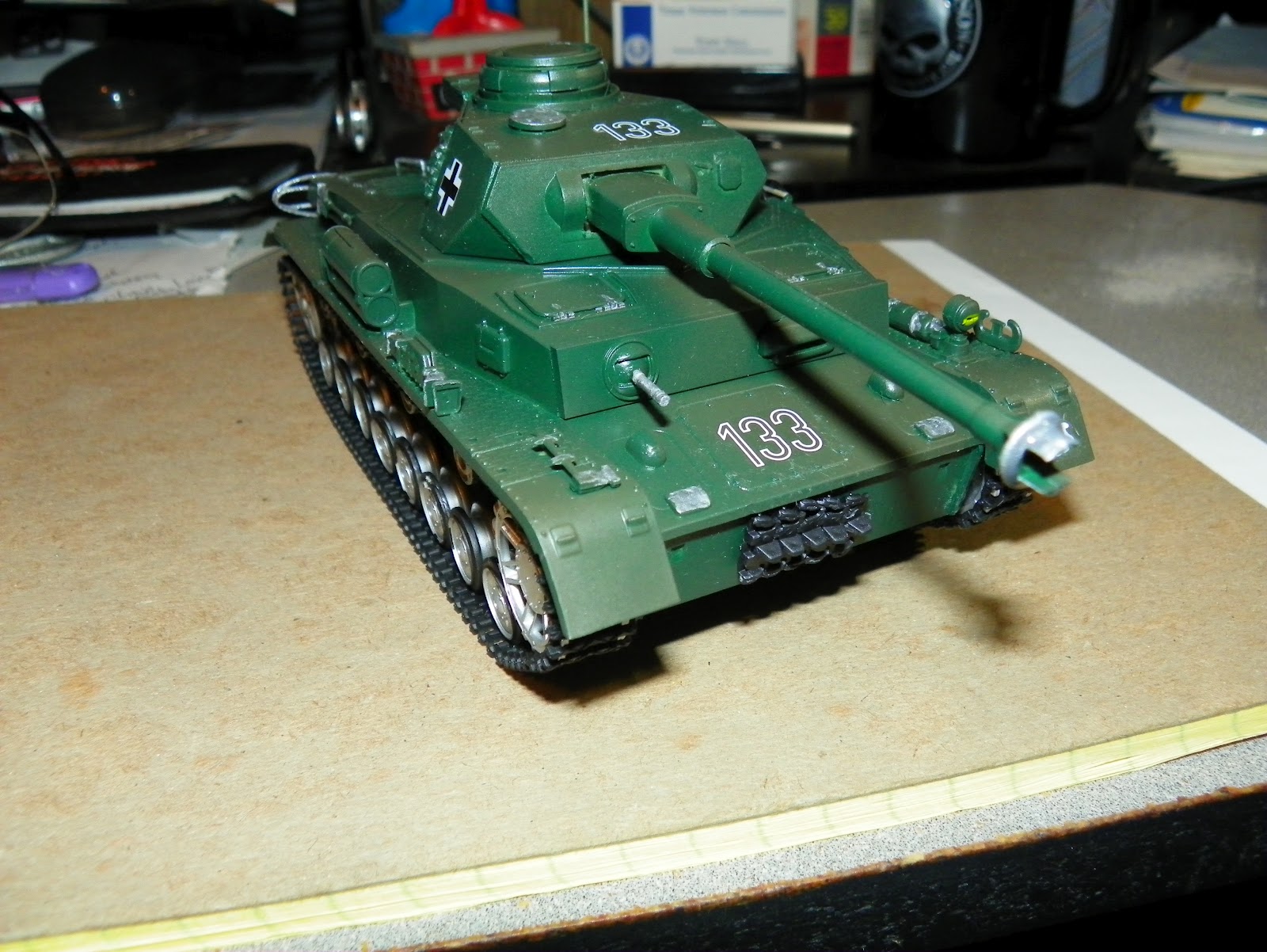
(B) The Mark III was one of Guderian's ideas to spearhead his armored attacks. There were two variations of the Mark III, one equipped with an anti-tank cannon, and the second was a support tank with a larger cannon. These became Mark III and Mark IV models. They weighed about 15 tons and were powered by V-12 Mercedes engines. In 1937 fifteen of the Mark III's were delivered to the Army just in time to take part in the takeover of the Sudetenland and the invasion of Poland. In 1940 the two models were updated with a 300hp engine and a 10-speed gearbox. They weighed 20 tons and featured a torsion bar suspension, a featured carried over to the Panther and Tiger model tanks that followed. By 1943 both models were pulled from service and their chassis became the platform for the Sturmgeschutz (mobile artillery).
(C) The Panther entered service in 1943 when the Russian T-34 overwhelmed the Mark III and Mark IV tanks. The Panther had the same 700hp Mercedes V-12 engine as the Tiger but its lighter weight made it faster. The 44 ton Panther could reach speeds of 35 mph. The 5-man crew had a 70-mm high velocity cannon and two MG34 machine guns. The front armor of the Panther was 80 millimeters thick but the side armor proved to be its downfall. Over 6,000 Panthers were delivered to the Wehrmacht, making it Germany's most prolific tank in World War II.
(D) The 62 ton Tiger was the most feared monster of World War II. Entering service in 1942 it was plagued with mechanical problems from the start. The Tiger featured armor 5 inches thick in front and 3 inches thick on the sides. German engineers took the 88-millimeter anti-aircraft gun and fitted it to the Tiger. It could fire a 100 pound shell over two miles with deadly accuracy. The Tiger also had two MG34 machine guns for the 5-man crew. The Tiger was used in both the Russian and North African campaigns. Just over 1,340 Tigers were built, but by the time they entered the war they had to be used in a defensive effort.
(E) The Sturmgeshutz (assault gun) is actually NOT a tank but a mobile artillery piece. It does not have a turret. The 'Stug' was built in high volume and also used at the forefront of any action. When the Mark III and Mark IV tanks became obsolete, their chassis was used as a platform for the Stug. They carried a 75-millimeter main gun plus one MG34 machine gun. The turret was expensive and four Stugs could be built for the same price as one Tiger tank. Built by Daimler-Benz, it entered service in 1940 and participated in every campaign thereafter. In 1944 Krupp Industries proposed a Stug with the 88mm gun, but it was never put into production. Over 10,000 of the Stugs were built. The model is painted in white, as it would have looked in the Battle of the Bulge, which was fought in a snowstorm.


(F) The Hanomag- Built by the Hannoversche Maschinebauag Company, which made trains, tractors, and military vehicles dating back to the 1830's. In 1937 the Hanomag 4-wheel drive personnel carrier entered service. It could carry 13 soldiers into battle with its crew of two. The company could not keep up with the demand and in 1941 BMW also began producing the Hanomag. Over 15,000 were built during the war. The only Allied comparison was the American GMC half-track, and despite being a little slower, the Hanomag offered its troops better protection with thicker sloped armor on the sides.